Free inside
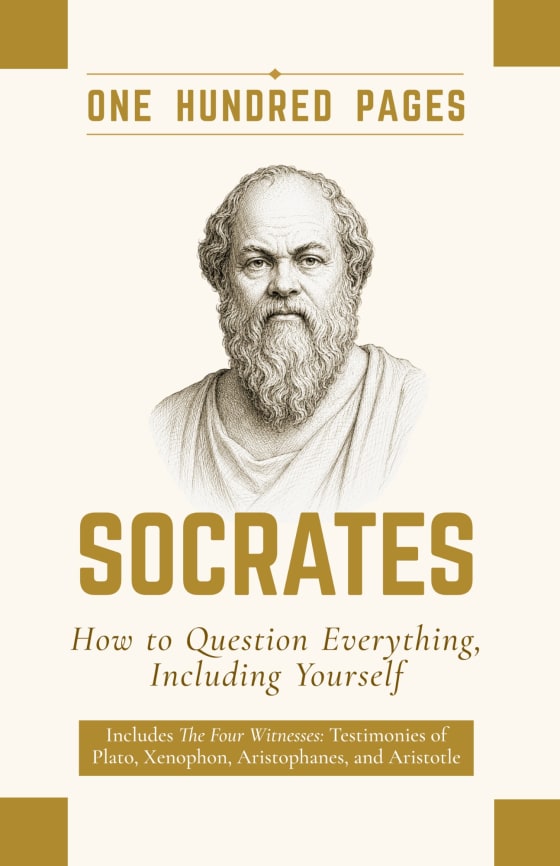
The FourThe Oracle at Delphi said that no one was wiser than Socrates. He knew he was not wise, and set out to prove the god had been misunderstood. In one hundred pages, the method he practised in the marketplace, turned on the one set of opinions you can actually change: your own.
He questioned the politicians of Athens, then the poets, then the craftsmen, and found the same thing in each: people certain of things they had never examined. For thirty years he went on asking such people what they meant and how they knew. Some found it liberating. Most found it humiliating.
In 399 BCE a jury of his fellow citizens condemned him to death for corrupting the young and disrespecting the gods. The real offence was making powerful people look foolish in public. At the trial he suggested that the city owed him his dinners at public expense, the honour it gave Olympic victors. About a month later he drank the hemlock, having refused a well-arranged escape.
He left no books, no school and no system. What he left is a method: a way of questioning that cuts through confusion, exposes hidden assumptions and forces clarity. It works on the old puzzles of philosophy, and it works just as well on whether to take the job. This book is a practical guide to using it. It is not a biography, and it is not Plato in summary.
Socrates offered no master theory of everything. He was interested in how to live, and he believed the answer required constant examination. These are the convictions that drove the questioning.
Wisdom begins with recognising how little you truly understand. The person who is sure they already know is blocked from learning. The person who sees their own ignorance can begin.
You can drift through life doing what is expected and believing what you are told, never asking why. Socrates called that a kind of sleepwalking. If you have not questioned your beliefs, you do not really hold them. They hold you.
Most people chase wealth, reputation and pleasure, and almost no one asks what kind of person they are becoming. Socrates reversed the priority: the condition of your character matters more than the condition of your bank account.
No one does wrong in full awareness, he argued. Much cruelty and cowardice come from confusion about what is truly good, so clarify the thinking and behaviour follows. The book also shows where this claim goes too far.
Do not accept an idea because it is popular, traditional or spoken by an authority. Ask what it means, ask for evidence, ask whether it clashes with something else you believe. Then turn the same scrutiny on your own opinions.
The unexamined life is not worth living.
A working method rather than a biography. Four parts take you from the man in the marketplace to tools you can use in tomorrow's meeting.
Why he still matters, his life in seven moments, from the stonemason's son to the cup of hemlock, and the Athens he spent thirty years provoking.
The five ideas he lived by, each in plain terms, with the common misreading cleared away and an exercise to make it your own.
Ten stress tests, from the argument you are losing to the question you are afraid to ask, a day lived as Socrates, a twenty-one-day discipline, where the method turns toxic, and an honest account of what he got wrong.
Where to meet him, since he wrote nothing: the essential texts, the best modern companions, the questions worth living with rather than solving, and the Socratic toolkit in brief.
The morning begins with a question, before the phone and before the newsfeed tells you what to think about: what am I assuming today? You do not need answers. The point is to begin the day awake rather than automatic.
At work, watch for unexamined consensus. Our customers want this; everyone knows the best strategy is that. Challenging every claim aloud would be insufferable, but on the ones that matter you can ask the calm Socratic question: I want to be sure I understand, so what supports that assumption? This is not disruption. It is clarity.
When someone says something you think is wrong, ask why they think it, then summarise their position in a way they would recognise. You may still disagree, but with understanding rather than caricature. Before sleep, the review: where were you clear, where were you automatic, where did you avoid the real question? That is all the examined life ever is. Not a finished state but a daily practice.
Taking Socrates seriously means seeing where he fell short. He believed that anyone who truly knew the good would do it, and underestimated how often habit, fear and desire win anyway. He compared governing a city to steering a ship and had little patience with letting ordinary citizens decide, without weighing the dangers of rule by experts. And a man who questioned nearly everything seems never to have questioned the exclusion of women and slaves from public life.
He distrusted writing, yet we know him only because Plato wrote. He was a master at demolishing false certainty and less adept at building something in its place. His choice to stay and drink the hemlock, when a boat was waiting, was partly a stand on principle and partly a choice about how his story would end. The book treats each of these directly. He would insist on it: even with him, especially with him.
This was an enlightening book about Socrates. The book opened my eyes on who Socrates really was, it was even more interesting that he wrote nothing, all the sources were from other thinkers like himself who knew him. Socrates asked questions to understand, not to write rules.
Socrates in One Hundred Pages successfully distills ancient philosophy into a highly accessible toolkit for modern readers. The book shines in its practical sections, particularly the ‘Twenty-One Day Discipline’ that provides actionable daily exercises like the ‘Definition Challenge’ and the ‘Assumption Hunt’ to help readers build a habit of self-examination. Hale also does a commendable job explicitly warning against the misuse of the Socratic method. It remains an excellent, concise starting point for anyone seeking to move past unexamined assumptions.
An interesting and easy-to-follow book that makes you think about life in a different way. I liked how it encourages you to ask questions, think for yourself, and look at things from a new perspective.
Socrates wrote nothing, so his companion could never be his own book. Your copy unlocks The Four Witnesses: Plato, Xenophon, Aristophanes and Aristotle, the four ancient sources for everything we know of him, set side by side in clear modern English, every passage cited.
Included with the book at no extra cost · your link is inside
The method he practised in the marketplace, distilled into a single evening’s reading you can put to work tomorrow.
Buy on AmazonFree with every copy: The Four Witnesses, the four ancient sources side by side, yours to read online.
A short note when a new thinker joins the series. Nothing else: no weekly letter, no sequence. Leave whenever you wish.