Free inside
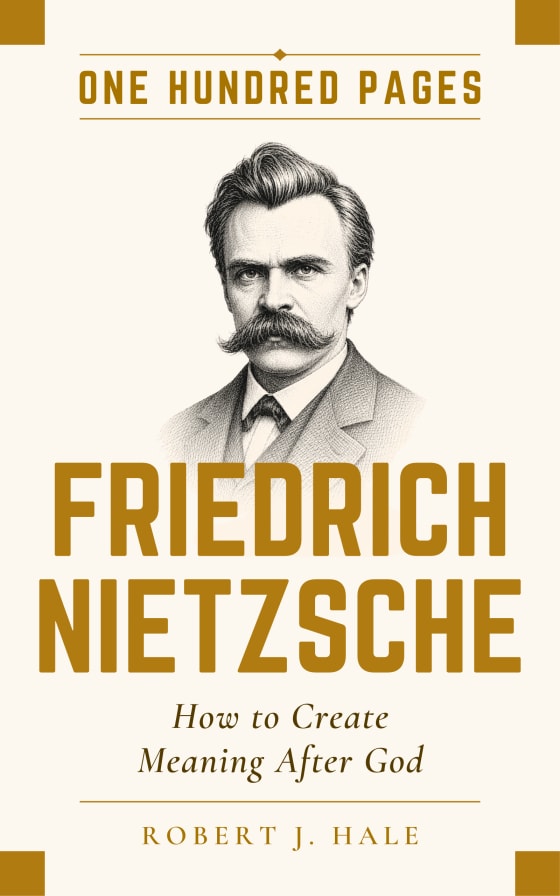
The EssentialThe most misunderstood philosopher who ever lived was not trying to destroy meaning. He was trying to teach you how to make your own. In one hundred pages, the ideas he built after the old certainties failed, made usable for an ordinary day.
A madman runs into a bright, crowded marketplace with a lantern in broad daylight, searching for God. The crowd laughs. Has he lost his way, they ask, is he hiding? The madman's answer stops them cold: God is dead, and we have killed him. Then he realises he has arrived too early. The news has not yet reached anyone's ears, even though they already live as if it were true.
That parable, from The Gay Science, is Nietzsche's most famous idea and one of his most misread. It is not an atheist's victory shout. It is a warning: remove the foundation under two thousand years of Western morality and meaning, and the structure does not stay standing by wishful thinking. Someone has to build a new one, and Nietzsche was one of the first to take that seriously rather than pretend reason alone could do the job religion had done.
The value of his answer lies less in comfort than in honesty. He has been blamed for horrors he despised, his words twisted by his own sister after his death, and reduced by strangers to slogans they never read past. Behind the noise is a method for building values you can actually stand behind, and this book distils it into usable form.
Nietzsche's philosophy, read properly, is not nihilism, and it is not permission for cruelty. It is a demand for honesty about where your values came from, and the discipline to build the ones you can actually stand behind.
The old religious foundations of morality and meaning have collapsed, and most people have not yet noticed. This is a diagnosis and a warning rather than a victory shout: the live question is what you build in the ruins.
Values are made, never found. Every rule you live by was created by someone, for some purpose, at some cost. See where yours came from, and you can never quite unsee it.
Stop living by inherited beliefs you never examined. Keep only the values you can affirm without flinching, and build the rest yourself, through discipline rather than indulgence.
Live so that you could will your entire life to repeat forever, suffering included. It is a standard for measuring how well a life is built, not a metaphysical claim.
The choice is always between building something of your own and poisoning what others have built. Resentment corrodes whoever holds it; creation is the only real cure.
No one can build you the bridge on which you must cross the river of life, no one but yourself.
A working method rather than a biography. Four parts take you from who Nietzsche was to a set of tools you can use tomorrow.
Why he still matters, his life in seven decisive moments, and the world of ideas he broke apart. Enough to understand the philosophy, no more.
The five core ideas, each explained in plain terms, with the common misreading cleared away and an exercise to make it your own.
Ten stress tests for modern life, a day lived as Nietzsche, a twenty-one-day discipline, where the philosophy turns toxic, and an honest look at what he got wrong.
Exactly what to read next and in which translation, the best modern companions, and the questions worth living with rather than solving.
The morning begins with a single question before the rush starts: what are you about to spend today on, and did you choose it? Nietzsche had no quarrel with obligation, only with obligation accepted unconsciously. If the day is genuinely yours, proceed with energy. If it is not, you may not be able to change it, but you can stop pretending that it is.
By mid-morning, resentment arrives on schedule: someone is promoted over you, credit goes elsewhere, a decision is made without you. The move is to notice the feeling without becoming it, and ask what you would build instead if the resentment were not there. Then do that, rather than brood.
The day was not heroic. Willpower was low by the afternoon, the mask slipped, and what showed underneath was closer to who you actually are. That is not failure. It is information. Multiply one slightly more honest day across thousands of days, and something that looks, from the outside, like a life you built rather than inherited begins to appear.
Taking Nietzsche seriously means taking his errors seriously too. His statements about women are frequently ugly and cannot be explained away. He despised democracy and equality and never saw what a thinker who lived through the twentieth century would have seen: what unchecked power does once it escapes the checks he dismissed as mediocrity. He attacked pity so sharply that the attack sometimes slides into an attack on care itself, and his own letters show more tenderness than his theory allowed.
This book treats those failures directly rather than airbrushing them, because engaging with a great thinker means agreeing where agreement is warranted and disagreeing where it is not. Nietzsche would have preferred that to discipleship. His entire project was to free people from borrowed authority, and treating him as one betrays it.
Your copy unlocks a second book at no extra cost: The Essential Nietzsche, a curated modern reader of his key passages, rendered fresh from the German and checked against it. Not extracts, not a sampler. The real texts, yours to read online alongside the guide.
Included with the book at no extra cost · your link is inside
The ideas he built after the old certainties failed, distilled into a single evening’s reading you can put to work tomorrow.
Buy on AmazonFree with every copy: The Essential Nietzsche, a curated modern reader, yours to read online.
A short note when a new thinker joins the series. Nothing else — no weekly letter, no sequence. Leave whenever you wish.