Free inside
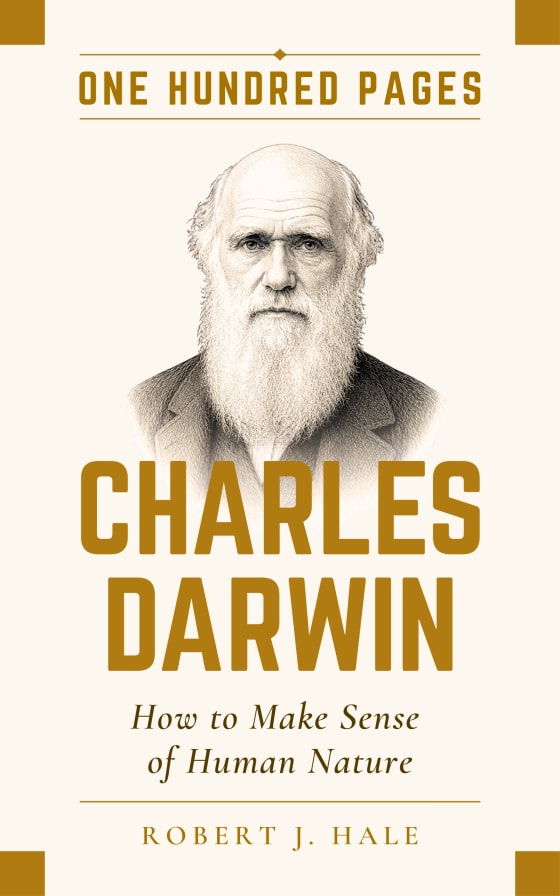
The EssentialYou are the animal that knows it is an animal. Charles Darwin is the reason you know. In one hundred pages, what he found, turned into tools for understanding your own instincts and choosing what to do with them.
He was a wealthy, conflict-shy naturalist who fled the operating theatre as a medical student and sailed round the world at twenty-two. Back in England, reading Malthus in 1838, he saw the mechanism that makes evolution work. Then he sat on the idea for twenty years, because he knew it would disturb believers, his own wife among them.
When he finally published, in 1859, he showed that living things look designed because survival filters them. In 1871 he said what every reader had already guessed: we were shaped by the same blind process as the orchid and the earthworm. Our cravings, our fears and our loyalties were built for a world that has gone.
Darwin found grandeur in that view of life, and he meant it. Understanding why you feel something does not excuse what you do with it. It explains it, and explanation is the first step towards change. This book is a practical guide to that step. It is not a biography, and it is not a condensed Origin of Species.
Darwin did not diminish humanity. He connected it to everything else. Read for use, these are the ideas that explain why you want what you want, and what you can do about it.
Humans are a species of great ape, shaped by the same forces as every other living thing. Our bodies, our instincts, our emotions, even our moral sense, evolved. Accepting this is the beginning of self-knowledge, and natural is not the same as good.
Living things look designed because survival filters them. Variation creates differences, and differential reproduction keeps the ones that work: random mutation, non-random selection, repeated over immense stretches of time. No plan is needed.
Evolution is not progress. It does not aim at complexity, intelligence or moral improvement. It is adaptation to local conditions, and a parasite is as evolved as a professor. The tree of life has no top.
Nature is not only competition. Sympathy, altruism and social bonds evolved because they helped our ancestors survive. Morality was not imposed from outside. It grew from our nature, and evolved does not mean fixed.
Knowing where aggression, tribalism and selfishness come from does not mean surrendering to them. Between the instinct and the act there is a gap, and that gap is where choice lives.
From so simple a beginning endless forms most beautiful and most wonderful have been, and are being, evolved.
A working method rather than a biography. Four parts take you from the young man on the Beagle to tools you can use on your own instincts.
Why he still matters, his life in seven moments, from the medical student who could not watch to the final works, and the world of fixed and separate species he overturned.
The five ideas that matter, each in plain terms, with the common misreading cleared away and an exercise to try on yourself.
Ten stress tests for the moments your instincts misfire, among them the craving that will not quit and the grief that will not end, a day lived as Darwin, a twenty-one-day discipline, where Darwinism turns toxic, and what he got wrong.
Which of Darwin’s own books to read, where to go next, the questions worth living with, and seven working tools to carry into an ordinary day.
Darwin lived methodically, and began each day walking his garden before breakfast, noting what had changed. Begin the same way: ten minutes watching your own mind before the world’s demands arrive. What thoughts arise, what cravings? Do not judge. You are gathering data on yourself, as he gathered data on barnacles.
Do the important work first, in a protected block. He rarely managed more than four hours of concentrated effort a day, and built the Origin sentence by sentence over twenty years. At midday, walk. He had a gravel path laid at Down House, the Sandwalk, and kicked a stone aside on each circuit. Problems that seem stuck often come unstuck when the body moves.
Through the day, pause and name the instinct at work: status, tribe, fear, craving. Naming it is the habit that makes choice possible. Darwin spent his life observing nature. Apply the same attention to your own. You are the subject of your most important study.
Darwin got the big picture right: natural selection explains adaptation, and common descent explains the diversity of life. He got a good deal else wrong. He had no idea how inheritance worked, and his own theory of it was mistaken. He insisted that change was always gradual, and he sometimes wrote of higher and lower organisms despite his own principle that evolution has no direction.
Worse, he was a man of his time, and his time was racist. He believed human races differed in mental capacity, a view now thoroughly rejected, and parts of his account of the sexes reflect Victorian assumptions more than biology. The book treats these failures directly rather than airbrushing them, and it is just as honest about the nights when understanding an instinct is not enough to beat it.
An interesting and engaging read for those interested in Darwin, evolution, human nature and psychology. This book makes a sometimes difficult and controversial subject easier to understand for those without a scientific background. Challenging assumptions and inspiring the reader to think about the connections between our past, present and future.
This book is wonderful, it really helps you get through the common misconceptions of what Darwin had presented to humanity and what is actually taking place in his work. What a beautiful understanding this author had and what a great way to help others understand.
An enjoyable and helpful book. Well written, great choice of fonts and design, keeping even a young reader interested. A must read.
Your copy unlocks a second book at no extra cost: The Essential Darwin, more than sixty passages in his own words, from the Origin, The Descent of Man and his letters, each with a short note on why it matters.
Included with the book at no extra cost · your link is inside
Where your instincts came from, and what to do with them, distilled into a single evening’s reading you can put to work tomorrow.
Buy on AmazonFree with every copy: The Essential Darwin, a reader of his own words, yours to read online.
A short note when a new thinker joins the series. Nothing else: no weekly letter, no sequence. Leave whenever you wish.