Free inside
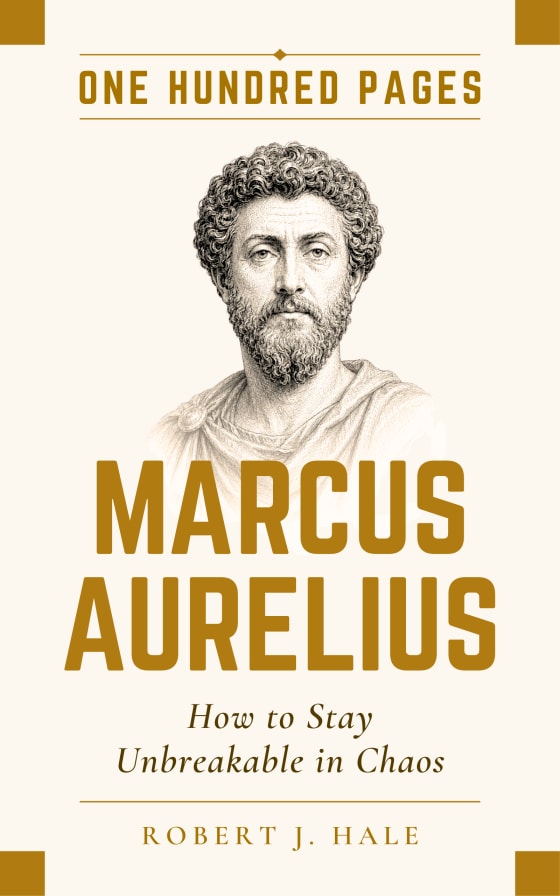
The completeA Roman emperor wrote the most useful book on resilience ever written, and he never meant anyone to read it. In one hundred pages, the ideas that carried him, made usable for an ordinary day.
Plague tore through his empire. Wars burned along the frontier. The people he trusted betrayed him, his children died one after another, and every morning he got up and governed anyway.
To stay sane, Marcus Aurelius wrote notes to himself: reminders on how to face fear, loss, anger, and the daily work of acting well when everything is going wrong. Those private notes became the Meditations, and eighteen centuries later they still work.
The value of the book comes from something other than elegant style or careful structure, since it has neither. Its value lies in the fact that it works. The practices have been used by readers across two millennia, by slaves and senators, soldiers and civilians, ancient Romans and modern professionals. This book distils them into usable form.
Stoicism, as Marcus practised it, is not grim endurance or cold indifference. It is clarity, focus and freedom: seeing reality as it is, directing energy where it can be useful, and keeping a steady mind in conditions that do not respect your preferences.
Your real power lies in your own judgements, choices and responses. Everything else belongs to the world. Stop wrestling what you cannot change and give your full effort to what you can.
Events arrive without built-in emotion. Your interpretation adds the pain or the peace. Between what happens and how you respond there is a gap, and in that gap you choose who you become.
Remembering death does not darken life. It sharpens it. Used well, mortality becomes a filter for what matters and a generator of gratitude rather than a source of dread.
Impediments do not interrupt your training. They are the training. What stands in the way becomes the way forward, because every difficulty is raw material for a quality you would otherwise have no occasion to develop.
Virtue is not a badge you earn once. It is a discipline you repeat. Each day you decide again, and the soul takes on the colour of its thoughts.
You do not control what happens to you, but you do control how you respond, and that response is the freedom that matters.
A working manual rather than a biography. Four parts take you from who Marcus was to a set of tools you can use tomorrow.
Why he still matters, his life in six decisive moments, and the world of ideas he argued against. Enough to understand the philosophy, no more.
The five core ideas, each explained in plain terms, with the common misunderstanding cleared away and an exercise to make it your own.
Ten stress tests for modern life, a day lived as Marcus, a twenty-one-day discipline, and an honest look at where the philosophy can turn cold.
Exactly what to read next and in which translation, the best modern companions, and the questions worth living with rather than solving.
The morning begins before you want it to. The alarm sounds, the bed is warm, and the list waiting on the other side of the duvet feels heavy. Marcus faced the same reluctance, and his answer was not to bark at himself or force himself up through raw willpower. He reminded himself what he was for.
By mid-morning something has already gone wrong: a plan collapses, a meeting is wasted, a message brings bad news. This is the day itself rather than a deviation from it. The moment to practise the core move arrives: ask very concretely what here is under my control, act on that, and decline to burn energy on outrage at the existence of difficulty.
The day was messy rather than clean or heroic. You got irritated, missed chances, forgot the practice and only remembered it later. So did Marcus. Multiply one slightly more intentional day across thousands of days and you get something that looks, from the outside, like wisdom.
Marcus Aurelius was not a saint. He chose his disastrous son Commodus as heir and broke the succession that had given Rome its best rulers. Christians were persecuted under his authority. Like every elite Roman, he accepted slavery without question. And he thought almost entirely about individual character, with little to say about the systems that do harm regardless of personal virtue.
This book treats those failures directly rather than airbrushing them, because the value of Marcus lies in watching a flawed person work seriously on himself and still make mistakes that mattered. That is a more realistic and more demanding standard than perfection.
Hale’s greatest strength here is restraint. He doesn’t dress Stoicism up as emotional suppression, nor does he present Marcus as some untouchable sage. The emperor emerges as flawed, overwhelmed, grieving. That vulnerability is what makes the philosophy land. These aren’t abstract thought experiments; they’re survival notes from a man whose world was actively falling apart.
Definitely one of the easiest to read books I’ve ever read. He finds ways and examples to apply the philosophy to modern life which is very useful. The try this section at the end of each chapter was excellent and shows how easily one can implement this philosophy in life. For such a short book it really exhausted the topic and approached it from all different angles.
Marcus Aurelius went through all kinds of insanely devastating situations and recorded his methods for coping with it all. He lived through plague, his empire burning, major betrayals and the loss of his children one after another. This book is the perfect starting point for someone at the end of their rope who needs a new perspective. I highly recommend it as a tool for dealing with life in general.
Honestly, a total lifesaver if you are stressed out and just need some quick, practical ways to keep your sanity together. It skips all the boring textbook talk and shows how a literal Roman emperor used these exact mental tricks to handle massive chaos. Plus it is super honest about the fact that he was a flawed guy, which makes the whole thing feel way more relatable.
An excellent introduction to Marcus Aurelius and Stoic philosophy. The writing is clear, engaging and easy to follow, while staying true to the core ideas of the Meditations. I found it very relatable. It inspired me to reflect on my own mindset and gave me a deeper appreciation for Marcus’s wisdom.
Two thousand years ago, an emperor journaled his way through plague, betrayal and grief. Hale distills those private notes into practical, no fluff tools for modern chaos. No philosophy degree required, just plain language on what we control and what we don’t. Ancient medicine for contemporary overwhelm.
This is a book I can see myself reading again and again, with different points standing out at different times depending on what is going on in my life. Full of useful and inspiring information on how to handle yourself and keep moving forward in chaotic and unpredictable circumstances.
This book has taught me so much. The lesson that stuck with me: be a little less at the mercy of events you cannot control, and a little more focused on what you can actually do.
I picked up this book because I was already familiar with Stoic philosophy and wanted to explore Marcus Aurelius in more depth. What I found was much more than a simple explanation of his ideas. The book makes Stoic principles feel clear, practical, and surprisingly relevant to modern life. I especially liked the exercises and practical suggestions at the end of each chapter, turning philosophy into something you can actually practise, not just read about. It not only helps you understand Marcus Aurelius better, but also invites you to understand yourself a little more.
Your copy unlocks a second book at no extra cost: the complete Meditations of Marcus Aurelius, in a fresh, readable, modern English edition. Not extracts, not a sampler. The whole work, yours to read online alongside the guide.
Included with the book at no extra cost · your link is inside
The ideas that carried a Roman emperor through plague, war and grief, distilled into a single evening’s reading you can put to work tomorrow.
Buy on AmazonFree with every copy: the complete Meditations in a fresh, modern edition, yours to read online.
A short note when a new thinker joins the series. Nothing else — no weekly letter, no sequence. Leave whenever you wish.