Free inside
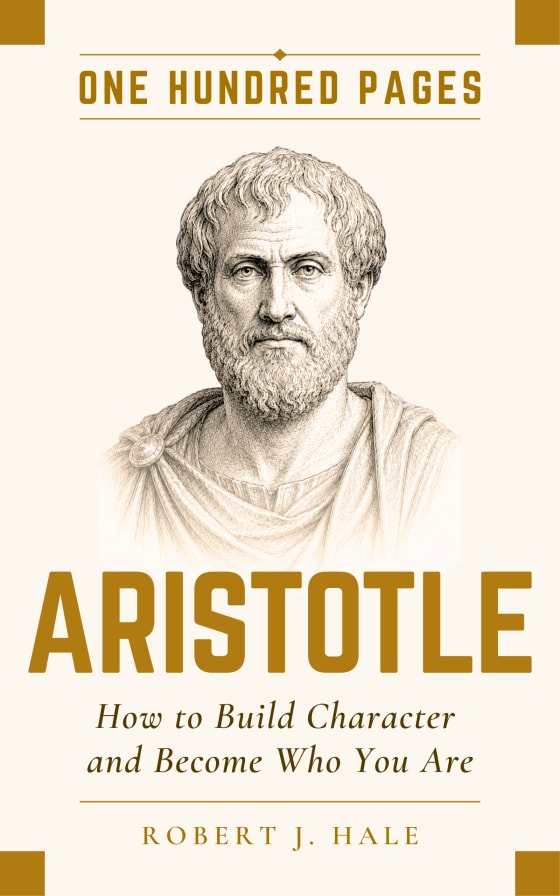
The NicomacheanFor the better part of two thousand years, his word ruled European thought. The real Aristotle was knee deep in a lagoon with a knife, checking. In one hundred pages, his account of how character is made, turned into a practical guide you can use this week.
He waded into the shallows of Lesbos to open up cuttlefish and see how they were built, trusting what he could observe over what merely sounded clever. The son of a court physician from Stagira, he spent twenty years in Plato’s Academy, tutored the young Alexander of Macedon, founded his own school in Athens, and was never quite allowed to belong there. He died in exile, at sixty-two.
Then he turned the same patient attention on the most complicated animal he knew, and asked what a human being is for, and what a human life looks like when it is going well. His answer, set down in the Nicomachean Ethics, is that you are not born with your character. You build it, act by act, the way a harpist is made by playing the harp.
Most of today’s guides to habits have kept his machinery and mislaid his point. This book gives you both. It is a practical guide to using his ideas in an ordinary week. It is not a biography, and it is not a condensed Ethics.
Aristotle did not write to be admired. He wrote to be useful. Read for use, these are the ideas that carry his ethics, each with an exercise that leaves you something written down.
The point of a human life is to function fully over a whole lifetime, becoming what you have it in you to be. His word is eudaimonia, and ‘happiness’ is a misleading translation: it names a feeling, where he meant a life going well as a whole.
You become brave by doing brave things and honest by doing honest things. Character is built by repetition, not intention, and every act is one more brick in the person you are turning into. Wanting to be patient does nothing.
Every virtue sits between two faults, one of excess and one of deficiency. Courage lies between cowardice and recklessness, generosity between meanness and waste. The skill is finding the right amount for this person, in this situation, now, and the right amount is often intense.
There is a virtue in knowing your own worth and claiming exactly what you deserve. Vanity claims too much. The failure we have nearly lost the ability to see is the other one: the false modesty that claims too little.
Rules run out. Be honest, yes, but with the grieving friend who asks whether the funeral went well? The master skill of a good life is phronesis, the trained judgement that sees what a particular case needs. No rule can supply it; only experience builds it.
You cannot flourish alone. Friendships of use and of pleasure are real but last only as long as their reason. The rarest kind, built on each wishing the other well for the other’s own sake, makes both people better, and it endures.
You build your character by what you repeatedly do until the person you are becomes the person you had it in you to be.
A working method rather than a biography. Four parts take you from the man in the lagoon to one question you can carry into any choice.
The biologist on Lesbos, the outsider in Athens who spent twenty years in Plato’s Academy, and the mistake most people make about what would make their life good.
The six ideas that carry his ethics, from the life that goes well to friendship, each in plain terms, each with an exercise to try on yourself.
A day of recalibration, from a sharp word at breakfast to a clear, unhostile no late in the afternoon, his decision filter, and the one thing to take away.
Contemplation, the life he ranked highest, an honest reckoning with where he was gravely wrong, and where to read next, starting with the Ethics itself.
It is a quarter past seven in the morning, and you have already failed. Someone said the small, thoughtless thing that lands on the exact nerve, and you said back something sharper than the moment deserved. This is where most accounts of the good life would rather not start. It is exactly where Aristotle would start, because his good life is not lived by people who never miss, but by people who miss, notice, and correct.
So read the failure rather than wallow in it. Too much or too little? This was an excess, too much heat too fast. Naming the direction is oddly steadying: the problem is not that you are a bad-tempered person beyond repair, but that on this provocation, at this hour, you released more than the moment warranted. By mid-morning the clearer faculty is back, and it asks a better question than the kitchen did: not how to win this, but what it actually needs. A short message, no grovelling, and the thing is closed before lunch.
The rest of the day is small things: ten minutes given properly when three distracted ones would have passed, the harder thing started in the unwatched hour, a clear and unhostile no when you are tired. When you put the day down, do not score it. It is not a perfect day. It is a day of recalibration, the ordinary unit in which character is actually built.
His physics is obsolete and his astronomy a museum piece, and none of that touches his ethics. Two failures do. He defended slavery, arguing that some people are slaves by nature, and he held that women possess reason in a form that lacks full authority. Because Aristotle became the authority, that view did not stay a private prejudice. It lent the prestige of the greatest philosopher in the world to the confinement of half the human race for the better part of two thousand years.
The book names both failures separately, and judges him by his own method: observe before you theorise. Had he looked at the people in front of him, his own empiricism would have forced the correction. And the machinery of his ethics, the function argument, habit, the mean, practical wisdom and friendship, does not depend on either claim. Taken seriously, it points the other way.
Your copy unlocks a second book at no extra cost: The Nicomachean Ethics, a curated modern reading edition that keeps Aristotle’s own order through all ten books. The guide shows you how to use his ideas. The Ethics lets you argue with the man himself.
Included with the book at no extra cost · your link is inside
How character is made, and how to make yours, distilled into a single evening’s reading you can put to work tomorrow.
Buy on AmazonFree with every copy: The Nicomachean Ethics, a curated reading edition, yours to read online.
A short note when a new thinker joins the series. Nothing else: no weekly letter, no sequence. Leave whenever you wish.